

A Rare Diagnosis and Remarkable Recovery: Jacob Mahan’s Journey at Chelsea Hospital’s Inpatient Rehabilitation
May 20, 2026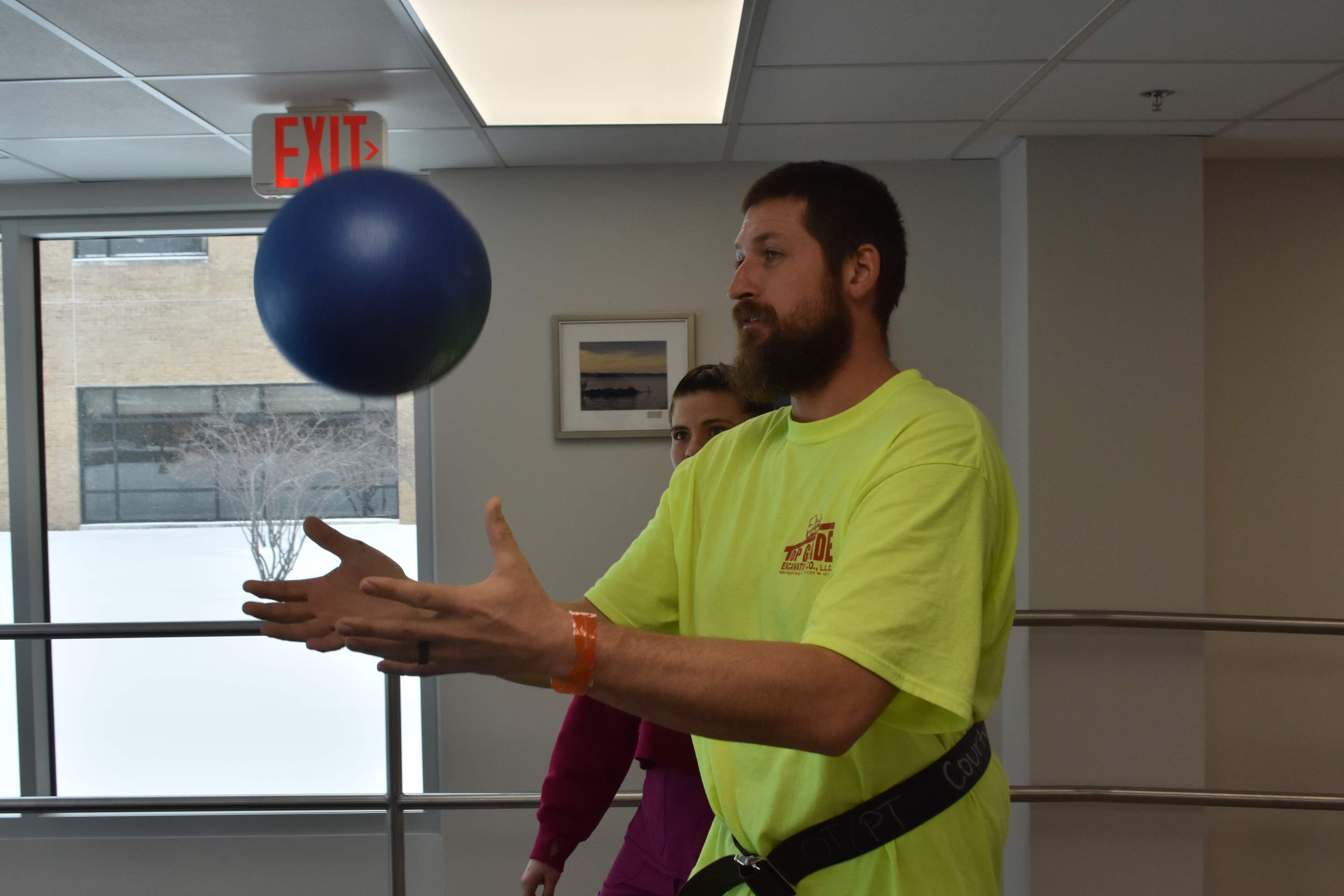
A lifelong Southeast Michigan resident and excavation worker in his family’s business, Jacob Mahan was used to working outdoors. He loved hunting, fishing and caring for animals on his small farm. Healthy, active and constantly on the go, Jacob never experienced even a simple winter bug. But that all changed in a matter of hours – Jacob couldn’t walk.
In December 2025, Jacob went ice fishing with friends after experiencing what seemed like a routine cold. Ice fishing is a normal winter activity for him. But shortly after returning home, Jacob began experiencing severe head pain, facial numbness and strange sensory changes.
His doctor suspected an ear infection, but Jacob’s symptoms continued to get worse over the next several days.
“By January 7th, I could barely get up,” Jacob recalls. “I couldn’t pick my head up. I couldn’t walk.”
His wife insisted they head to the emergency room.
At Chelsea Hospital, Jacob’s care team began performing tests to rule out a stroke or other causes of his symptoms. Cayla Stevens, an occupational therapist, recognized the symptoms as Guillain-Barré Syndrome, a rare neurological condition where the body’s immune system attacks the protective covering of the nerves. According to the Centers for Disease Control and Prevention, only an estimated 3,000 to 6,000 people develop Guillain-Barré syndrome each year in the United States.
“Your body just keeps attacking itself, even after the cold,” Jacob shared. “It could happen, basically, to anyone. It’s a random pick of the draw.”
A spinal tap confirmed the diagnosis. Jacob’s case was especially uncommon, beginning in his face and head before spreading to his arms and legs, a rare variant known as Miller Fisher syndrome.
At his most severe point, Jacob lost reflexes, coordination and strength. He could not touch his nose, hold his head upright or walk on his own. He arrived at the Chelsea Hospital in a wheelchair as his nerves continued to shut down.
“The neurologist had me take my hands and put them out in front of me. He told me to touch my nose and I couldn't touch my nose. I was poking myself in the eyeball. My motor control systems were really affected,” Jacob said. Dr. Umesh Verma, MD, neurologist, and the acute care team worked closely to ensure timely treatment and monitoring as Jacob’s symptoms progressed.
Jacob was immediately treated with five days of IVIG (intravenous immunoglobulin) therapy to stop the attack. Because Jacob also has Factor V Leiden, a clotting disorder, his care required close coordination across specialties, making his treatment even more complex.
Thankfully, the condition was recognized early enough to prevent full paralysis.
Inpatient Rehabilitation at Chelsea Hospital
After acute treatment, Jacob was transferred to Inpatient Rehabilitation at Chelsea Hospital to begin rebuilding his strength and mobility. Under the care of Dr. Cory Wernimont, MD, Physical Medicine and Rehabilitation, Jacob began an intensive, coordinated rehabilitation program focused on restoring independence.
“When I got to inpatient rehab, I knew that’s where things were going to change,” Jacob said. “I was ready to work.”
When Jacob arrived, he required a wheelchair and a walker. Everyday tasks were physically and mentally exhausting. Through daily occupational and physical therapy, Jacob regained coordination, balance and strength.
“They never treated me like a number,” Jacob said. “They pushed me, but they also understood what I was going through.”
Jacob progressed rapidly and walked out of the building using a walker when he was discharged. That was something that felt impossible weeks earlier when he was bound to a wheelchair.
Gratitude and Hope
Jacob is deeply grateful to the care teams at Chelsea Hospital who supported him through one of the most frightening experiences of his life.
“If we had waited even a little longer, it could have been full paralysis,” he said. “The quick diagnosis, the treatment and the rehab made all the difference.”
Continued Recovery and Reflection
After Jacob was discharged in January of 2026, he continued outpatient physical therapy to address lingering nerve damage, eye coordination issues and sensory changes. While much of his independence has returned, recovery from Guillain-Barré is ongoing.
“You have good days and bad days,” Jacob explained. “If I overdo it, my body lets me know.”
The experience forced Jacob to slow down and temporarily step away from parts of his life he loved, including caring for his animals. Still, he maintains his perspective and determination.
Today, Jacob continues moving forward. He is walking independently, rebuilding strength and returning to the life he loves. By sharing his story, he hopes others will listen to their bodies and seek care when something doesn’t feel right.
Learn more about Inpatient Rehabilitation at Chelsea Hospital.
Learn more about Inpatient Rehabilitation