

A living kidney paired exchange helps donor improve friend’s life
August 17, 2026
By: Val Enti
Tags: Kidney transplant, Kidney Failure
Scott Pitcher knew he was born with only one kidney, but that didn’t stop him.
“My whole life I’ve been active. I started running marathons when I was 14. I traveled around the world with a backpack for six years. I worked for the post office as a mailman for 36 years,” Scott said.
Kidney cancer
The first Christmas after Scott retired in 2020, he got COVID, which required him to postpone a hernia operation he had planned. Two weeks later, he saw blood in his urine for the first time in his life. After seeking medical care immediately, Scott learned that scans identified a mass on his only kidney.
Scott’s specialists worked together to perform a biopsy of his tumor during his hernia surgery. Unfortunately, the biopsy revealed that Scott had kidney cancer and it had spread to nine lymph nodes. Due to the location of the tumor, his medical team could not save his kidney.
“I knew I was going to lose my kidney, and I had to go on dialysis. At that time, my focus was to learn all I could about dialysis,” said Scott.
On April 5, 2021, Scott’s kidney was surgically removed, and two days later, he had his first dialysis treatment.
“It was intense — I had problems right away.”
Eventually his body adapted to the dialysis routine, three days a week, and Scott was shocked that he was walking around with no kidney.
Making the transplant waiting list
Having cancer delayed Scott’s opportunity to be placed on a waiting list for a kidney transplant.
“You have to be cancer-free for two years to be on the list,” he said. So, he knew he had a long wait.
Then in January 2022, Scott’s oncologist performed another scan and found that some of the remaining lymph nodes had enlarged significantly. So, Scott had six rounds of chemotherapy causing further delay to be on the transplant list.
“Chemo restarted the ‘two-year clock’ for me to apply for a kidney transplant,” he said. “Thankfully, the chemo stopped the cancer, so the clock started again after treatment was over.”
Scott spent four years and seven months on dialysis. During that time, he lost new friends he had met during treatment.
“I’m a strong Christian, but I know I couldn’t have done it without my faith. If I had gone through this without knowing God, I would have been a total wreck.”
Scott’s wife, Laura Pitcher, along with his family, was a tremendous support during this trying time.
An avid cyclist before his kidney surgery and chemotherapy treatment, Scott was able to get back in shape and even competed in a 40-mile bike race in 2023. “I was slow, but I did it,” he said. Scott continued to challenge his body through exercise throughout his time on dialysis.
When Scott made it to the two-year mark following his cancer treatment, he was thrilled to be referred to the Trinity Health Grand Rapids Kidney Transplant Center, which has performed more than 3,200 kidney transplants during its 52-year history.
After his initial meeting in June 2024, Scott underwent extensive testing. In Feb. 2025, he was officially placed on the transplant list for a deceased donor kidney, which comes from someone who has died and made the decision to become an organ donor.
A friend from work
Then out of the blue something amazing happened.
Matt Evans, a friend from work, contacted Scott and said, “I’d like to give you one of my kidneys.” Matt and Scott had worked together for 20 years, and they had grown close through family crises and shared faith.
“Matt is one of the humblest men I’ve ever met,” said Scott. “He would do anything to help a friend. A number of guys said they would give me their kidney when I was first diagnosed with cancer. But no one came through. Matt is 100% selfless.”
Scott was shocked and honored by Matt’s offer. However, they found out immediately that they weren’t a blood match, so Scott was not going to get Matt’s kidney. Then Scott decided to show Matt some brochures about the Paired Kidney Exchange program through the National Kidney Registry.
He recalls saying, “Matt, you may want to check this out. There is another option if you want to help me out.”
Living kidney paired exchange
A living kidney paired exchange (also called a kidney paired donation or swap) is a way for incompatible donor/recipient pairs to still get a transplant by exchanging kidneys with another pair in the same situation: Your donor will donate their kidney to another recipient they do not know in exchange for a compatible or better matched kidney for you.
Trinity Health Grand Rapids Kidney Transplant Center is proud to be the only adult kidney transplant program in Michigan to partner with the National Kidney Registry, the largest kidney exchange program in the world.
“To be honest, I was probably thinking about donating my kidney to Scott two years prior to his being placed on the deceased donor list. I felt a super strong pull to do something,” Matt said. “After learning about the Paired Kidney Exchange program, I talked it over with my wife Sue (who is a nurse), and we decided to go through with it.”
Matt’s motivation
“We went through a journey of receiving a heart and lung transplant to extend the life of our daughter Lily who was 5 at the time, so we felt Scott’s situation very personally,” Sue said. “Scott uplifted Matt during a very dark time following the death of our daughter.”
“For a couple of years after Lily’s death, I was really depressed,” Matt said. “Scott was one of the guys at work who kept an eye on me. He had my back. He did more for us than he could even imagine.
“For me, this was an opportunity to pay it forward. Indirectly, I could still help Scott out,” said Matt. “I don’t know if I will ever meet the person I gave my kidney to (it was shipped to New York), but that is not what is important. Compassionate reflection shows we are all a community to help each other.”
Scott’s transplant surgery and care
Matt’s testing for the paired kidney exchange was completed in September 2025. Scott’s final approval for surgery was in October 2025.
Five days later, a match was identified for Scott, and a surgery date was set: Nov. 11, 2025 — Veteran’s Day.
“I don’t know if words can describe the transplant team and the care following surgery,” Scott shared. “I felt so much love on that 8th floor from every nurse, doctor, and tech. It was off-the-charts care. It was amazing. A couple of nurses even prayed over me during the night shift. From the minute I checked into the hospital until the minute I left, the care was 100%.”
Life after the transplant
What is life like now, following the transplant?
Matt: “I feel the same as I did with two kidneys. Seeing Scott makes us feel good. He is doing great. He has always had a fire and passion.”
Scott: “I’m so happy I am not doing dialysis anymore. I feel free. I can finally enjoy retirement. I’m getting my joy back. I have no fluid restrictions, which were very difficult for me during dialysis. And my energy level is great. I’m like a different person.”
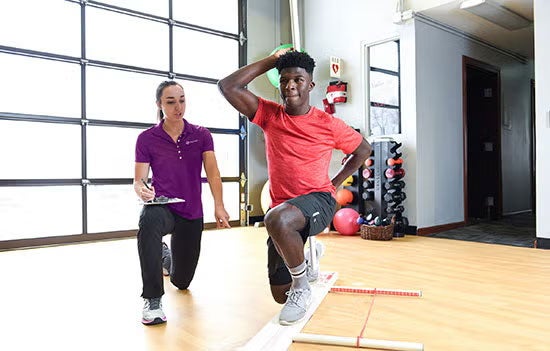
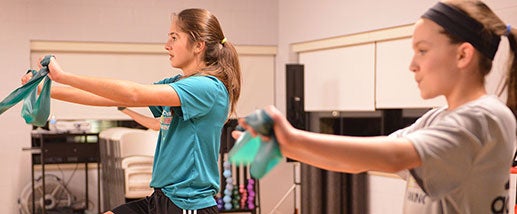
Scott credits his quick recovery to the Kidney Transplant Wellness program, which allows transplant patients to participate in a post-transplant rehabilitation program to get their strength back after transplant. The Kidney Transplant Center also open to pre-transplant patients in order to improve their exercise capacity and to make them better candidates for transplant. Both programs are free of charge, thanks to a grant from the Saint Mary’s Foundation.
“I’ve cycled almost 1,200 miles since January,” Scott said. “I’d like to compete in the World Transplant Games in Belgium next year.”
Hope for others
For thousands of people around the world waiting for a kidney, paired exchange serves as a beacon of hope. One person's willingness to undergo the act of paired donation often sets in motion a chain of beautiful and selfless acts, where individuals give and receive the chance for a better life.
Both Matt and Scott turn to their faith for comfort and inspiration.
“When I went to dialysis, I would tell myself, 'You’re still alive, Scott. This I what you have to do to stay alive. You need to watch your diet and fluid intake, go to your appointments, and stay active.'
“But trusting in God was the most important thing,” Scott added.
Without his faith, Matt doesn’t know if he would have donated his kidney.
“Helping Scott was a God calling. Sue saw that, too, and she supported me through it. There is nothing more satisfying than having a calling from God and following through on it. And then there is Lily. Sometimes I hear her say, ‘Good job, Dad.’”
The Trinity Health Kidney Transplant Center in Grand Rapids has clinic locations in Muskegon and Traverse City.